


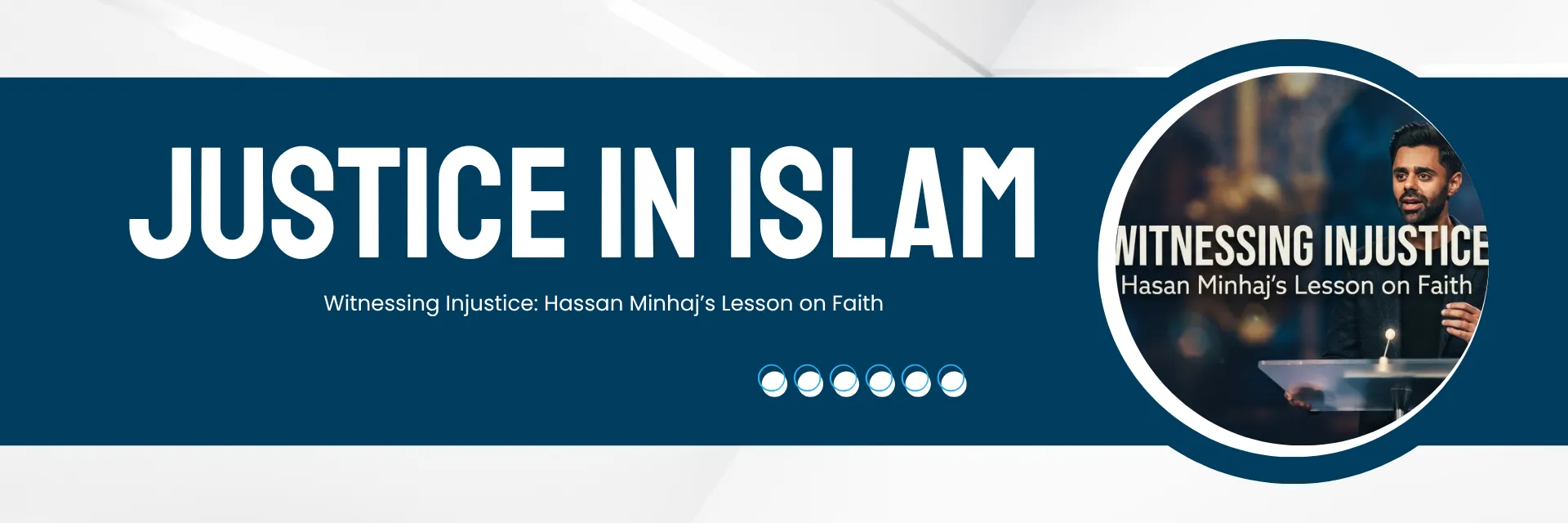
Some questions stay with us long after the news has moved on. As a student of SourceCode Academia , I often find myself thinking about the injustice and suffering we witness every day, and how quickly we are expected to scroll past it. How do we carry so much pain in our hearts and still go on with our lives? Where do we put the grief of a world that seems to grow more unjust with every headline?
Hassan Minhaj, a 39-year-old Indian-American comedian, has struggled with this same question. He admits he has always found it hard to reconcile his faith with the suffering he sees around him, and he wonders how anyone could keep the "Microsoft Excel accounting" of all the pain and trauma humanity has endured. It is an honest question, and one many of us have quietly asked ourselves.
If you have ever watched the world's suffering and felt that same heaviness, this reflection is for you.
Let us turn to the words that finally brought Hassan comfort, and ask ourselves not only why injustice exists, but where real justice is found.
The one perspective that has ever comforted him, he told his therapist, came from his father:
"Hassan, I notice your generation is obsessed with this idea of justice, of absolute justice. But that's going to be impossible in this visible realm. Absolute justice is only possible in the Hereafter, in the spiritual realm with God."
His father's words echo a verse in the Qur'an:
"Indeed, Allah never wrongs [anyone] even by an atom's weight. And if it is a good deed, He will multiply it many times over and will give a great reward out of His grace." (Qur'an 4:40)
For his father, this belief is what lets him sleep at night after watching news reports full of horrific injustice.
Dr. Maté on Justice, Suffering, and Human Responsibility
Hassan later brought the question to his therapist, Dr. Gabor Maté, a Holocaust survivor and trauma expert.
Dr. Maté listened and then responded:
“What your father said is beautiful. I just see it differently because I don’t have a worldview that includes an afterlife. Let me put it in my own way.
There’s an old Jewish teaching about healing the world. It says, ‘The task is not yours to finish, but neither are you free to not take part in it.’
I think that’s the point. We may never be able to fix all the injustice in the world, and no single person can finish that work. But that doesn’t mean we can simply walk away from it. We still have a responsibility to do our part.
That’s how I make peace with it. I don’t wait for an afterlife to make things right. I try to show up and do what I can here and now.”
This idea also resonates with the Qur’anic teaching:
“Cooperate with one another in goodness and righteousness, and do not cooperate in sin and transgression…”
(Qur’an 5:2)
Hassan was still not completely convinced.
“But what if doing the right thing means suffering yourself?” he asked.
Dr. Maté replied:
“Suffering is part of being human. Buddha recognized that, too. We can’t always choose what happens to us, but we can choose how we respond to it.”
The Qur’an similarly reminds believers:
“We will certainly test you with a touch of fear and famine and loss of property, life, and crops. Give good news to those who patiently endure.”
(Qur’an 2:155)
Hassan still felt that there was a limit to what human beings could accomplish. People are imperfect, and our time in this world is short. For him, complete and final justice cannot rest in human hands.
“Human beings are deeply flawed, and we only have a short time here,” he reflected. “We can try to make things better, but only God can keep a complete account of everything—every act, every suffering, and every injustice. And honestly, that belief is what gives me peace.”
The Qur’an expresses this sense of ultimate accountability:
“Surely to Us is their return, then surely with Us is their reckoning.”
(Qur’an 88:25–26)
Faith, Justice, and Our Responsibility to Others
be part of the good that God wants to bring into the world?
We may not be able to solve every injustice or change everything around us. But we can choose how we live, how we treat others, and what we contribute to the world. Perhaps our responsibility is simply to do our part sincerely and leave the final outcome to Allah.
The Qur’an reminds us:
“Say, ‘Surely my prayer, my sacrifice, my life, and my death are all for Allah — Lord of all worlds.’”
(Qur’an 6:162)
The Secular Worldview: Responsibility and Personal Effort
There is some value in comparing the worldview of a confident secular person with that of a believer who is struggling with questions of faith and justice.
A hopeful secular person, whether materialist or spiritual, may focus on creating a better world here and now. In their own way, they try to build a life that feels meaningful while reducing suffering, correcting injustice, and creating what they see as a better society.
But they soon realize that this is not something they can accomplish alone. They need to work with people who share similar values and goals. They develop their skills, build relationships, and contribute to the kind of community they want to live in.
For such a person, everyday choices can carry a heavy sense of responsibility. If they do not believe in divine intervention, an afterlife, or a higher power that will ultimately correct the injustices of this world, they cannot simply leave everything to fate or expect someone else to fix it. They understand that the life they experience is shaped, at least in part, by the choices they make and the effort they put in.
That sense of personal accountability can become a powerful motivation. They know that if they want a better life or a better society, they have to take responsibility for helping create it. They cannot wait for someone else to do the work.
The Qur’an also reminds us of the importance of personal effort:
“…and that each person will only have what they endeavoured towards.”
(Qur’an 53:39)
The Conscious Muslim: Faith, Justice, and Responsibility
A conscious Muslim, guided by the Qur’an and aware of humanity’s responsibility as Allah’s vicegerent on Earth, carries a strong sense of purpose. This responsibility is not limited to seeking justice for oneself or one’s family; it also includes caring about justice, dignity, and well-being for others.
Such a believer sees their faith as a call to contribute to what is good in the world. They strive to promote justice, compassion, and responsibility while using their abilities to benefit the wider community.
The Qur’an reminds us:
“Remember when your Lord said to the angels, ‘I am going to place a successive human authority on earth.’”
(Qur’an 2:30)
Taking this responsibility seriously means developing knowledge, skills, character, and the ability to serve others. A conscious Muslim seeks not only personal success but also a meaningful contribution that can benefit those around them.
The lives of the early Sahaba and the Khulafa al-Rashidun are often looked to as examples of how faith, leadership, responsibility, and service can come together.
Loss of Purpose and the Decline of Muslim Leadership
As Islamic history moved forward, examples of the leadership and sense of responsibility seen among the early Sahaba became less common. The central problem, from this perspective, was a gradual loss of the higher purpose that was meant to guide Muslim leadership and society.
Some rulers and leaders began to place greater importance on political power, wealth, and personal interests than on justice, accountability, and their responsibilities before Allah. When worldly interests became more important than the pursuit of lasting reward in this life and the Hereafter, the wider interests of the community could be pushed aside.
The Qur’an reminds us:
“But you only prefer the life of this world, even though the Hereafter is far better and more lasting.”
(Qur’an 87:16–17)
The consequences of this shift were not limited to individual rulers. When leadership loses its moral and spiritual direction, the effects can spread throughout society. Political divisions, insecurity, and dependence on outside powers can weaken a community over time.
As people became more focused on survival, religious understanding could also become mixed with political interests and the pressures of the surrounding environment. Over generations, this may have contributed to partial or distorted interpretations of Islamic teachings.
The result was a gradual weakening of the confidence, unity, and sense of responsibility that had once encouraged Muslims to see their faith as a source of both personal guidance and social responsibility.
The Qur’an warns:
“And do not be inclined to the wrongdoers or you will be touched by the Fire. For then you would have no protectors other than Allah, nor would you be helped.”
(Qur’an 11:113)
From this perspective, the decline was not simply caused by external forces. External pressures certainly mattered, but internal weaknesses—particularly the loss of purpose, accountability, and unity—also made Muslim societies more vulnerable to them.
The Qur’an offers a broader principle for understanding change:
“Indeed, Allah would never change a people’s state of favour until they change their own state of faith.”
(Qur’an 13:11)
The lesson, then, is not simply to look backward and blame past rulers or outside powers. It is to recognize that meaningful renewal begins with restoring faith, responsibility, justice, knowledge, and a clear sense of purpose.
Building a Stronger Ummah Through Collective Action
The future of the Muslim Ummah depends not only on individual change but also on what we are willing to accomplish together. Like the early Sahaba, Muslims can learn to see themselves as part of a larger community with shared responsibilities. That begins with returning to the Qur’an, following the example of the Prophet Muhammad ﷺ, and working together despite our differences.
Collective action does not mean that everyone must think or work in exactly the same way. It means recognizing the values we share and using our different skills and abilities for the common good. Scholars, educators, professionals, community leaders, families, and young people all have a role to play.
This also requires developing the knowledge, character, and practical abilities needed to fulfill the responsibility of being Khalifat al-Ard , or stewards of the Earth. Justice, compassion, honesty, and accountability should not remain abstract ideas; they should be reflected in how communities are organized and how people treat one another.
The Qur’an reminds us:
“And hold firmly together to the rope of Allah and do not be divided…”
(Qur’an 3:103)
One of the first steps toward meaningful renewal is developing a sound and thoughtful understanding of the Qur’an. Misinterpretation can create confusion and division, while knowledge, humility, and sincere learning can help bring people closer together.
The task is too great for any one person to complete alone. Real change requires people to learn from one another, support one another, and take responsibility for their communities. Each person can contribute something—knowledge, time, skills, resources, leadership, or simply a commitment to doing what is right.
When these individual efforts come together, they can become a collective force for positive change. That is where renewal begins: not with waiting for someone else to act, but with each of us recognizing our responsibility and then working together, InshaAllah.